 ExamTeX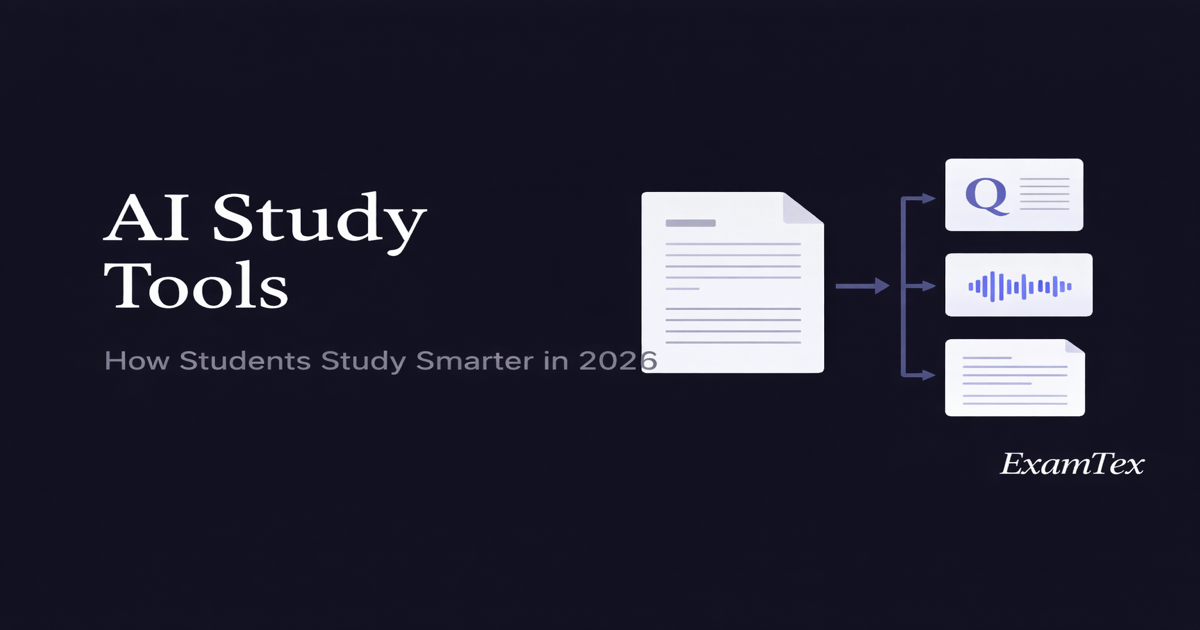
AI Study Tools in 2026: How Students Are Using AI to Study Smarter
The best AI study tools in 2026 fall into four categories: flashcard generators, practice exam creators, summarizers, and audio study tools. Used correctly, they compress hours of study preparation into minutes — letting you spend more time on active retrieval practice, which is what actually builds lasting memory.
AI study tools have moved well past novelty. In 2026, students at universities across the world are using AI to generate flashcards from lecture slides, take practice exams built from their own notes, and listen to audio summaries of dense readings during their commute. The technology works — but only if you use it in ways that support active learning rather than replace it.
Categories of AI Study Tools
The AI study tool landscape has coalesced into four main categories, each serving a distinct part of the study workflow.
Flashcard Generators
These tools analyze your notes, slides, or textbook passages and automatically produce question-and-answer pairs formatted for spaced repetition review. The best ones produce atomic cards aligned with the minimum information principle rather than dense, multi-part cards that are hard to schedule and review. ExamTeX generates flashcard decks from uploaded course materials and schedules them using spaced repetition so you review each card at the optimal time.
Practice Exam Creators
Practice exam generators produce full-length tests in the format of your actual course exams — multiple choice, short answer, essay, problem sets. The most effective tools do this from your own notes rather than generic content, ensuring alignment with what your instructor actually taught. This category has seen the most rapid development in the past two years, with accuracy and question quality improving substantially.
Summarizers and Concept Extractors
These tools condense long readings or lecture transcripts into key concepts, definitions, and frameworks. They are useful for initial orientation to a dense topic but carry a risk: passive reading of AI-generated summaries can create the same fluency illusion as re-reading original notes. Use summaries to navigate material, not to replace studying it.
Audio Study Tools
Audio tools convert notes or summaries into spoken study content — essentially a personalized podcast on your course material. ExamTeX generates study podcasts from your notes that you can listen to during commutes, workouts, or other low-attention activities. This is not a substitute for active practice, but it is an effective way to build familiarity with a topic before a focused study session, or to reinforce material in otherwise dead time.
The most effective AI study stack combines tools from at least two categories: a passive tool for initial exposure (summary or audio) and an active tool for retrieval practice (flashcards or practice exams). Passive tools without active retrieval produce familiarity without real learning.
How to Use AI Effectively (Not Just Conveniently)
The core error students make with AI study tools is treating output as finished learning. Generating a set of flashcards and scrolling through them is not studying — it is reviewing, and reviewing is far less effective than retrieval practice. The flashcards are a scaffold; the learning happens when you force yourself to answer them without looking.
Similarly, reading an AI-generated practice exam with the answer key open defeats the purpose. Take the exam first, under closed-note conditions, score it honestly, and only then review the answers. The struggle of attempting retrieval before you know the answer is exactly where the learning occurs.
A student uploads a week of biology notes to ExamTeX and receives a 30-card flashcard deck, a 20-question practice exam, and a 12-minute audio summary. She listens to the audio on her morning run, takes the practice exam that evening without her notes, reviews the questions she missed, then starts the flashcard deck with spaced repetition scheduling. Three tools, three different cognitive modes, all working on the same material.
The Role of AI in Active Learning
AI tools are best understood as preparation and scaffolding for active learning — they do not replace the cognitive work of testing yourself, explaining concepts, solving problems, and applying knowledge in new contexts. What they do is dramatically reduce the time spent on low-leverage tasks.
Before AI tools, creating a 50-card flashcard deck from a lecture took 45 minutes to an hour. Generating a practice exam from your notes required either finding past exams or manually writing questions, which most students never did. AI compresses the preparation time from hours to minutes, leaving more time for actual retrieval practice.
When AI Helps vs. When It Hurts
AI study tools help when they generate active practice material from your own course content, when they give you more retrieval practice attempts in the same amount of time, and when they remove friction from building good study habits.
AI study tools hurt when they become a substitute for engagement — when generating a summary feels like studying, when creating a flashcard deck is treated as equivalent to reviewing it, or when AI-written explanations replace your own attempts to articulate a concept. The research on learning is consistent: cognitive effort produces durable memory. Tools that reduce your cognitive effort in the wrong places reduce your learning.
A useful rule: AI should handle the logistics of studying — organizing, formatting, scheduling, and generating material — while you handle the cognition — recalling, applying, explaining, and connecting ideas. The more cleanly you separate these two roles, the more effective your AI study stack will be.
Building Your AI Study Stack
A practical starting point for most students is a single integrated tool that covers multiple categories. ExamTeX handles flashcard generation, practice exam creation, and audio summaries from a single upload of your notes, which eliminates the overhead of managing multiple platforms. Once you have a workflow that produces reliable active practice material from your course content, you can add specialized tools as needed.
The most important variable is not which tools you use but whether they are generating active practice rather than passive review. Start there, measure your exam results, and adjust from what you observe about your own learning.
FREE
Try ExamTeX
Upload your notes and get AI-generated flashcards, practice exams, or study podcasts in under a minute.
Frequently Asked Questions
Are AI study tools considered cheating?
Using AI to generate study materials from your own notes — flashcards, practice questions, summaries — is not academically dishonest. It is functionally equivalent to using a tutor or a study guide. The distinction that matters is whether you are using AI to do your thinking for you (submitting AI-written essays, for example) versus using it to study more effectively. Tools like ExamTeX are designed explicitly for the latter.
What is the best AI tool for creating practice exams?
The best practice exam generators work from your own course material rather than generic content. ExamTeX generates multiple-choice, short-answer, and essay questions directly from your uploaded lecture notes, ensuring the questions reflect your instructor's emphasis and terminology. Generic AI-powered quiz platforms are useful for common subjects but cannot replicate the specificity of questions built from your own notes.
Can AI study tools replace actual studying?
No, and students who treat them that way will underperform. AI tools are most valuable as force multipliers — they reduce the time spent on low-value tasks like making flashcards or searching for practice questions, freeing up that time for active learning activities like self-testing, solving problems, and explaining concepts. The cognitive work of retrieving and applying information must still be done by you.