 ExamTeX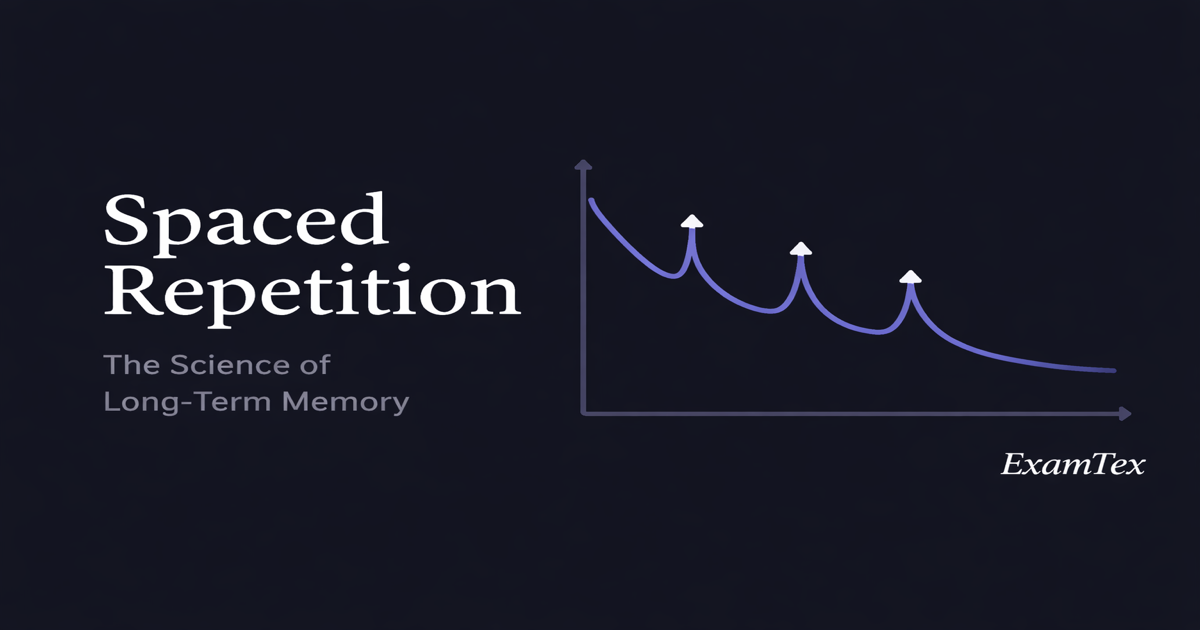
Spaced Repetition: The Science of Long-Term Memory
Spaced repetition is a study technique that schedules review sessions at increasing intervals. Instead of cramming everything the night before, you review material just as you are about to forget it — strengthening memory each time. Research shows it can improve long-term retention by 50% or more compared to massed study.
Most students study by reading their notes repeatedly and hoping the information sticks. It rarely does — at least not past the exam. Spaced repetition is a fundamentally different approach, one grounded in decades of memory research, and it is arguably the single most powerful technique available to any student who needs to retain information for the long term.
What Is Spaced Repetition?
Spaced repetition is a learning method that schedules review sessions at increasing intervals over time. Instead of studying the same material every day, you revisit it just before you are about to forget it. Each successful recall pushes the next review further into the future. Each struggle brings it back sooner.
The result is that you spend less total time studying while retaining far more. The method exploits two well-documented phenomena: the forgetting curve and the spacing effect.
The Forgetting Curve
Hermann Ebbinghaus documented the forgetting curve in the 1880s. He found that without any reinforcement, humans forget roughly 50% of new information within an hour, around 70% within a day, and close to 90% within a week. The curve is steep at first and flattens over time.
The good news is that each time you successfully recall something, the forgetting curve resets — and it resets at a shallower slope. Your memory of that item becomes more durable with every retrieval. This is why reviewing material once a week for four weeks is far more effective than studying it for four hours in one sitting.
The goal of spaced repetition is not to review everything — it is to review each piece of information at exactly the right moment. Too early, and you waste time on material you already know. Too late, and you have already forgotten it and must relearn from scratch.
The Leitner System
Before software existed to automate review scheduling, students used the Leitner system: a set of physical boxes labeled 1 through 5. Every new flashcard starts in Box 1 and gets reviewed daily. When you answer correctly, it moves to Box 2 and gets reviewed every other day. Correct again, it moves to Box 3 and gets reviewed weekly. An incorrect answer at any point sends the card back to Box 1.
The Leitner system is elegant because it concentrates your attention on difficult material while still reviewing easy material at the right intervals. It is a manual implementation of the same logic that drives modern spaced repetition algorithms.
You are studying anatomy and add a card: "What are the four chambers of the heart?" You answer it correctly on day 1, day 3, and day 10. Each correct retrieval moves the card to a longer interval. By the time your exam arrives three weeks later, you have reviewed it three times instead of thirty — and retained it just as well.
How Modern Algorithms Work
Software-based spaced repetition systems like SM-2 (the algorithm behind many flashcard apps) calculate the next review date based on how confidently and correctly you answered each card. The algorithm shortens the interval when you struggle and extends it when you answer easily. Over time it builds a precise model of what you know and what you are about to forget.
ExamTeX applies this same logic to the flashcards it generates from your course notes. Rather than creating a static deck you review linearly, the system schedules each card individually based on your performance, so your study sessions automatically focus on the material that needs the most attention.
Combining Spaced Repetition with Active Recall
Spaced repetition tells you when to study. Active recall tells you how to study. Active recall means forcing yourself to retrieve information from memory — rather than re-reading it — every time you review. Flashcards are the most direct way to practice active recall: you see the question, attempt the answer without looking, and then check.
Combining spaced repetition with active recall is the foundation of efficient studying. If you only do one thing differently after reading this, make it this: stop re-reading your notes and start testing yourself on them instead.
Practical Tips for Getting Started
Start small. Add no more than 20 to 30 new cards per day when you are first building a deck. Review your due cards every day without skipping — the intervals are calibrated to your forgetting curve, and missing a day throws off the schedule for everything that was due. For more card-writing strategies, see our guide to effective flashcard study techniques.
Write your own cards whenever possible. The process of deciding what to put on a card is itself a learning activity. If you use AI-generated flashcards, which ExamTeX can produce directly from your lecture notes, take a moment to read and edit each card before you start reviewing. Cards you understand and have engaged with will be reviewed more efficiently than cards you are seeing for the first time during a review session.
Consistency beats intensity. Thirty minutes of spaced repetition every day for two weeks will outperform five hours of cramming the night before — and the information will still be there a month later.
The Bottom Line
Spaced repetition is not a study hack. It is a systematic application of how memory actually works. Students who build it into their daily routine consistently outperform those who rely on massed practice, and they do so with less total study time. The learning curve to get started is shallow — all you need is a good set of flashcards and the discipline to review them every day. For a complete study workflow that integrates spaced repetition with other techniques, see our notes-to-exam-ready guide.
FREE
Try ExamTeX
Upload your notes and get AI-generated flashcards, practice exams, or study podcasts in under a minute.
Frequently Asked Questions
How often should I review flashcards with spaced repetition?
It depends on where each card sits in your review schedule. Newly learned material should be reviewed within 24 hours, then at expanding intervals — roughly 3 days, 1 week, 2 weeks, and 1 month. Flashcard tools like ExamTeX automate this scheduling so you never have to calculate it manually.
Is spaced repetition better than re-reading notes?
Yes, significantly. Re-reading creates a feeling of familiarity that is often mistaken for learning. Spaced repetition forces active retrieval, which strengthens the memory trace each time and dramatically improves long-term retention compared to passive review.
Can spaced repetition work for conceptual subjects, not just facts?
Absolutely. While it is most obvious for vocabulary or dates, spaced repetition works for any material you can phrase as a question and answer — including concepts, processes, formulas, and even code syntax. The key is writing good cards that require genuine retrieval, not just recognition.